 ThinkSpatial
Telling a Robot Exactly Where, and Keeping It When You Change Robots
Pointing misses by about 60 cm, and words miss too. I built a room where you press the exact spot, mark how your things may be held, and a different robot keeps those rules without being told again.
An AI tells a robot, "Put that couch over there."
Over where? Even if I point, I end up saying "scoot it a little to the left. A little more. A little more." When I could have just shown it the exact spot.
The problem isn't the person. Pointing just isn't precise. In 2015, Sven Mayer and colleagues at the University of Stuttgart had people point at targets on a wall from two and three metres away, about seven to ten feet. Even the most accurate way of working out where each person was pointing missed by 61 centimetres on average. That is about two feet, most of the width of an armchair.
Saying it in words doesn't fix it. Researchers test this with a set of 100 photos of real homes and offices, each with a sentence naming an empty spot in the picture. A model gets one right when the point it picks lands inside that spot. The best result I could find, from Enshen Zhou and colleagues in 2025, gets 71 of the 100 right. Almost three in ten land somewhere the sentence didn't mean.
And where a thing goes is only part of it. The other part is how it's handled. This September, Geonho Kim, SooGon Kim and Jongmin Lee found that robot hands told "grab the handle, not the body" tend to treat the part they were told to avoid as one more place to grab. Their fix brought touching that part down from 58% of tries to 17%. That is still about one try in six.
So I stopped trying to describe places better and built a room where you can name one exactly.
An address for every spot
The floor of the room is a grid, a1 to h8, like a chessboard laid over the floorboards. Each square is 60 centimetres across, about two feet. Each square is split into nine parts, numbered the way a phone's keypad is numbered, so e7·5 is the middle of square e7 and e7·1 is its near left corner. When that still isn't close enough, each part splits nine ways again.
You don't describe the spot. You press it.
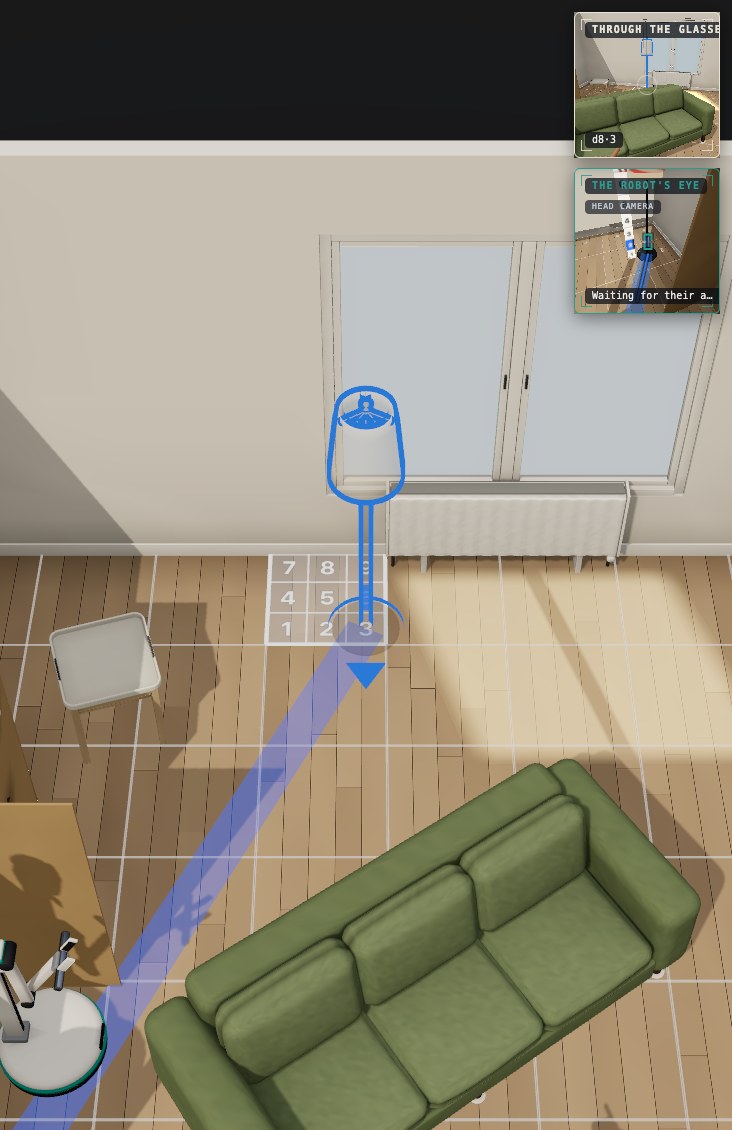
An address on the thing, too
Each thing in the room has numbered sections, counted from a marked end. The couch runs s1 to s8 along its length, and its s1 end has a small sewn label, so nobody has to guess which end is which.
So you can say "hold it at s3", or "never hold it at s8". In the room, s8 of the side table is its loose top, and nobody should lift it by that. You can also mark squares of the floor to keep clear, like the swing of the door or the walkway to the window. A robot may not set anything down there, carry anything through, or stand there.
These rules are yours. They are kept on your side, with you, not inside whichever robot happens to be connected. That is the point of the whole thing: my memory of how I like my stuff held, and where.
The robot shows you first
When you ask for something, the robot doesn't move. It sends back an offer: where it would hold the thing, where it would set it down, which way it would face, and the way it would go. You see the offer drawn in the room in blue, from above, from where you are standing, and from the robot's own camera. The card under the picture says it in one line, for example "Hold at s4 to s5, set down on e7·5".
Then you answer. Yes. Not like that. Finer. Turn it a quarter. Face it toward the window. Hold it somewhere else. Nothing moves until you say yes, and once it does, the robot tells you what it is doing as it goes.
Your rules aren't suggestions the robot is asked to remember. Every offer is checked against them before you see it. An offer that would hold a section you said never to hold, or take a path through a square you kept clear, is turned down by the room and never reaches you. Given how often "don't hold it there" goes wrong when it is only words, I didn't want that rule to rest on a robot's good intentions.
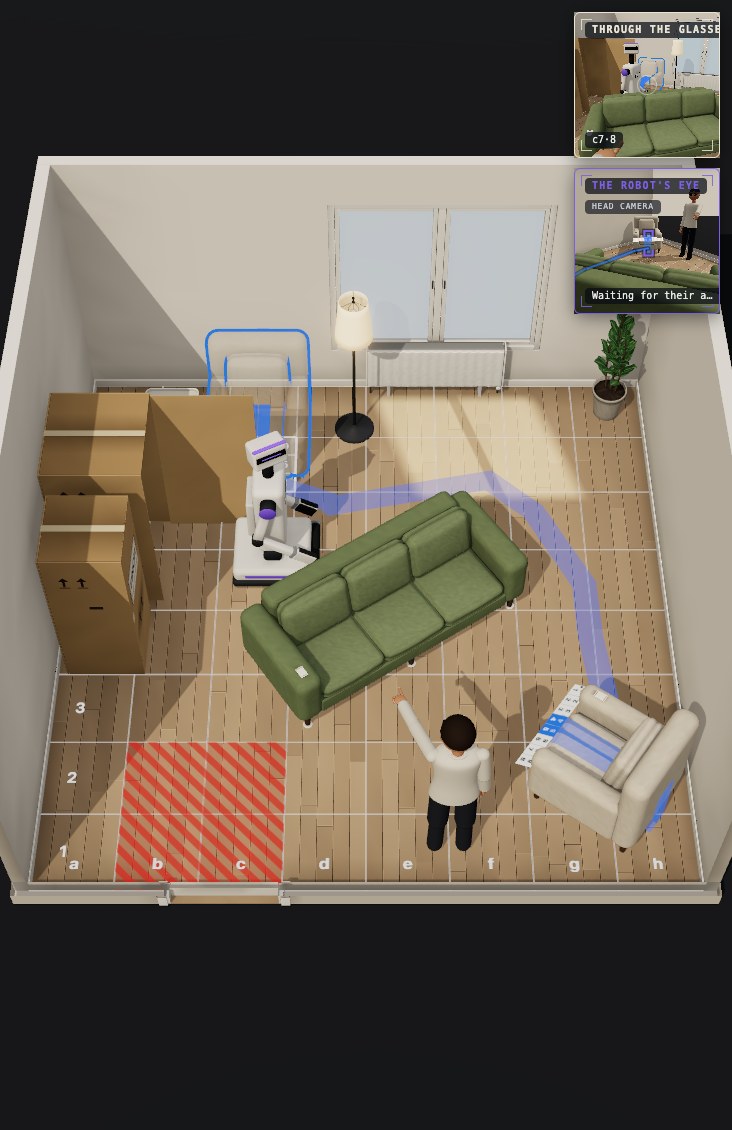
Change the robot, keep the rules
This is the part I care about most. Say you get a brand new robot. The first thing you should be able to do is connect it to the place where your rules already live, and have it work within them. Not teach it everything again. If my rules live inside one robot, I lose them the day I replace it, or the day a second machine from a different company comes into the house.
The room has two robots, and only one is connected at a time. One has a single arm and lifts 4 kg, about 9 pounds. The other has two arms and does the heavy work. Both are made up. The small one's numbers are within what real one-arm home robots lift; the big one's go past anything I could find on sale, and I found no robot that slides a couch the way it does in the room.
Today I ran the swap as a scripted test over the internet, with two separate programs: the room in one, the robot in another, joined by a one-time code the way you pair a smart-home device. With the small robot connected, I marked the couch never to be held at its s1 end, kept the door's swing clear, and asked for the couch at e7·5. The small robot said it couldn't move it: the couch weighs 60 kg, about 130 pounds, far past what it can slide.
Then I connected the big robot. The first request it got already carried both rules. Its first offer held the couch at s4 and s5 and kept out of the door's swing. I didn't repeat anything. The offer came back 0.6 seconds after the ask. When I changed the hold to s3, the new offer came back in 0.2 seconds. I said yes. It reported each step and set the couch down exactly where I had asked.
Then I stopped the robot's program altogether, asked for the armchair while it was gone, and started it again without a code. It came back, offered the armchair, and moved it once I said yes. Nothing had to be set up again.
A robot built by someone who never saw my code
Both of those robots were mine, so that test only proves the rules survive a swap. The real question for anyone who builds robots is whether their robot could join from the written description alone.
So I tested that too. An AI agent playing an engineer at another company got one document, the written contract for how a robot connects, and nothing else: no code, no examples of mine. It wrote its own robot program in Python in about 14 minutes and ran it through the same test over the internet.
Its first try failed at the most important step. My room didn't tell a new robot where things already stood, and the contract told it to assume everything was still in storage. Bringing the whole room in from storage meant one thing's path crossed a square I'd kept clear, so it couldn't offer anything at all. When it worked around that, it set off for the hall to fetch a couch that was standing in the middle of my room. That was the contract's fault, not the robot's. I changed it so every request now says where each thing stands, and its next try passed all 28 checks.
Then I fixed every other place it had told me it had to guess, and gave the finished contract to a second agent starting from nothing, again with no code of mine. It built its robot in about 16 minutes. On its very first run, the robot passed all 40 checks: the swap with my rules already set, a correction, a no, a stop in the middle of a move and carrying on, a restart with no code, and being disconnected at the end. It still wrote down 14 smaller things it had to guess where the test didn't reach, such as what should win if I say stop while it is stepping out of a square I just kept clear. Each of those now has an answer in the contract, and in the four places where my own code did the wrong thing, I fixed the code. The test now has 42 checks, and both robots, mine and the one written from the contract alone, pass all of them.
What this is close to
Robotics researchers have been working on parts of this for years. NASA's Affordance Templates (2015) let an operator place grasp points and waypoints relative to an object and store them in a format meant to carry over to other robots; they ran on the Valkyrie and Robonaut 2 humanoids, among others. Researchers at NYU Tandon (2017) had people drag virtual blocks onto a grid over a tablet's camera view to tell a two-armed robot where to put them. Robot vacuum apps already let owners draw no-go zones on a map of their home.
What I'm testing is a different thing to keep. Not a task written for a robot, but a person's own rules for their own things: where this goes, where it may be held, where it must never be held, what stays clear. Kept on the person's side, sent to whichever robot connects, and checked against everything that robot offers.
What it is not, yet
The robots are simulated. No physical robot has connected, and no robot company has tried it yet.
The check holds a robot to its word, not its hands. It catches an offer that breaks your rules. It can't catch a real robot whose grip slips onto the part you marked while it works. A physical robot would need to report where its hands actually are, and the room would need to check that too.
And five labelled things in one room is a demonstration. In a real home with hundreds of things, who numbers the sections and marks which end is s1? That is still open.
If you build robots
If you work on a robot or the software that runs one, and you'd like to see whether yours could join a room like this, I'd like to hear from you at hello@thinkspatial.ai. The connection is a short written contract: how a robot says what it can do, in numbers; how it offers before it moves; how it takes an answer; and how it reports what it is doing. I'd rather try it with your controller than guess at what it needs.
What I'm offering is the part between the person and the robot. You keep the robot and everything that makes it move. The person keeps their rules, whichever robot they use.